Amalia's debut novella, Six steps to survival will be published in 2027 by Scylla.
Modern slavery. Bodily autonomy. What risks are worth taking?
The path to freedom is never a straight line.
Amalia likes writing about
Liminal spaces.
In the intersection between the real and the unreal, the built and the wild, people behave differently when they're not perceived. Is that who they are?
Motherhood
How do you equip your children for a life in an environment alien to you?
Commercial pressures and the ethics of trade and colonisation.
It's impossible not to engage with the legacy of colonisation when you live on land over which someone else has custodial responsibilities and you're world building for your own stories.
Is there ever an ethical way for an outsider to cohabit with an indigenous people?/
Is there ever such a thing as terra (or extra-terra) nullius?
repeating patterns
Intelligences that aren't human.
How much of the way we think is driven by the organic structures in which we live?
Independence / dependence / modern slavery
It's impossible when you live in Australia, when you work in an office big enough to have an HR department (even a good one like ours), not to think about the ways in which people have always been vulnerable to being treated as objects, as resources.
How the balance is so easy to tilt, if someone has enough power and too little regard for fellow humans.
Given humans are the scarcest resource in space, how do you preserve them? Does an employer get to make all the decisions? Do the individuals?
People and relationships
can people change
how do you bridge the gap between different world outlooks, different life experiences
Bodily autonomy and pregnancy
Who gets to decide whether you can be pregnant / have to try to be pregnant / have to stay pregnant / and with what?
Getting things wrong -
and making them right
ABOUT AMALIA
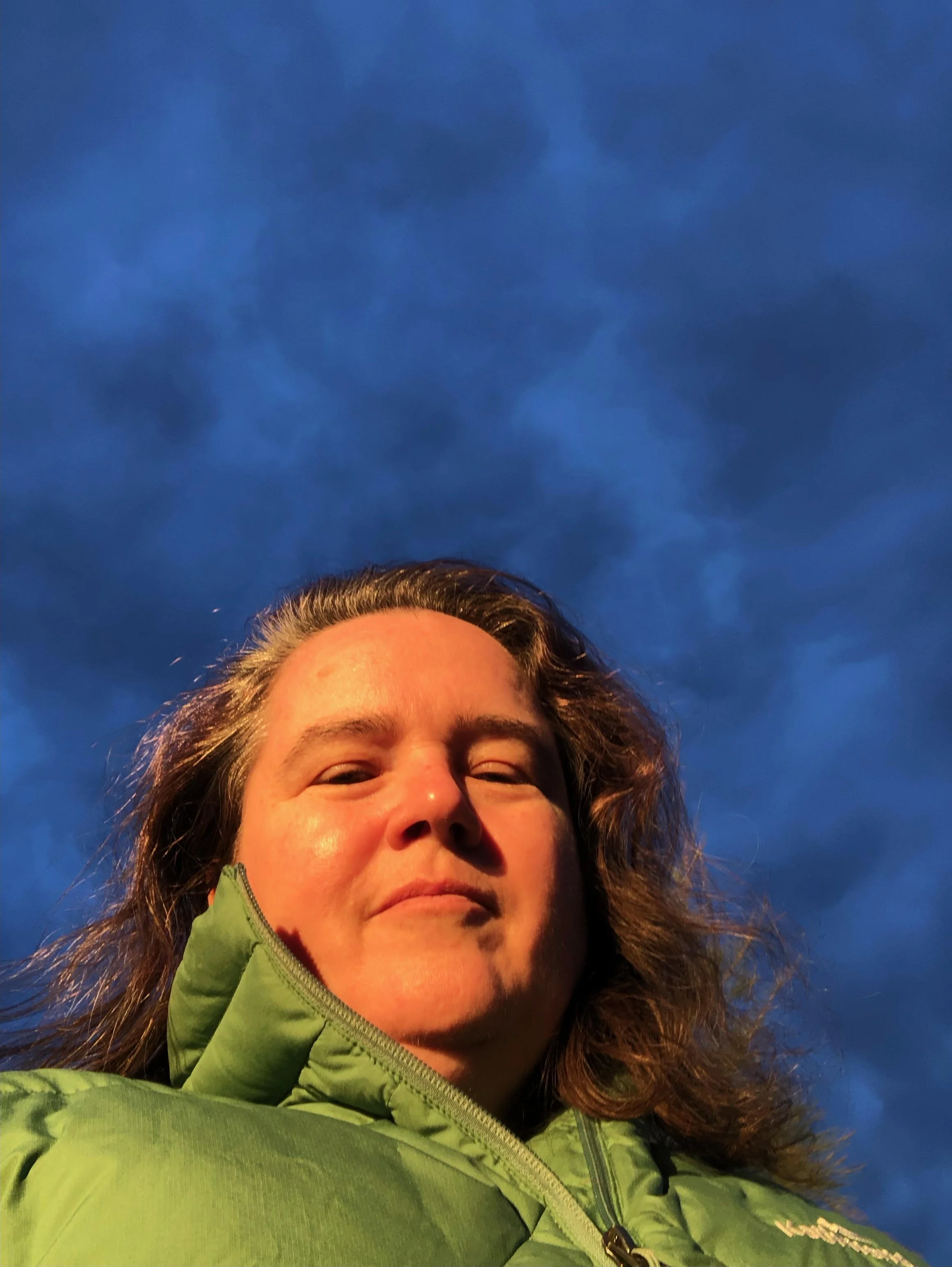
Amalia is, in no particular order, an emerging writer, a mother, a bi woman married to a man, a lawyer, a former latchkey kid, and waiting for the right moment to adopt another greyhound.
She lives and writes on Gadigal land, where she's keen on looking up into its night sky, and down into its day water.
What has Amalia written?
Amalia has been published in Overland (Spring 2024: You’ll find what you need in the Gilgan op shop (go here)) the University of Sydney Nothing rhymes with orange anthology 2024 (Consensus), A little better elsewhere anthology 2025 (The Whole of the Moon) and the Emerging Writer’s Festival Speculate Anthology 2024 (No one is alone). The Last Days of the Inner West Dog Walking Coven was long-listed for the Peter Carey Short Story Competition. To Sacrifice Your Queen will be published in Scylla Publishing's anthology Who Am I? in 2026.
Amalia has volunteered as an editorial assistant for Overland since 2025, and has a Masters of Arts in Creative Writing from University of Technology, Sydney. She has dustier degrees from the University of Sydney in law and science, with honours in theoretical chemistry. As part of her day job, she’s written extensively in relation to legal aspects of commercialising intellectual property, and drafted supply agreements that grapple with modern slavery issues and scarce ingredients.
"Kate doesn’t lose as many tools as she thinks she will, the low gravity holds most things near enough for an outreached hand to snag. Only one makes orbit, a wrench lighter than a newborn, that had twisted itself out of her hand with misapplied force. It turns itself on end and on end, lazy acrobatics. They’d never thrown Simon outside the compound on Ithaca, only inside. He’d squealed when he’d flown, let loose of gravity, and squalled when he’d fallen, gravity bound once again, higher gravity than this, certain to fall. She watches the wrench go until she can’t see it for all the stars bright in the black…"
"VESTA: SOME MIGHT SAY THAT THE RISKS YOU’RE RUNNING’S NOT WORTH IT TO TALK TO ME. YOU MIGHT WANT TO REASSESS THE RISK, STYX.
STYX: AH, VESTA, YOU FOOL. THE RISK IS THE REASON TO RUN."
"Ben doesn’t want to be known. She doesn’t want anyone to see her like that, even if it’s only for the hour that Kate says Ursula gives them. It’s too risky. A person could do anything to you, if they know you like that. And it doesn’t fix anything, doesn’t protect you against anything. People still die, out of nowhere. Holes open up and air disappears, and you could die, loved or unloved. Love doesn’t matter."
"Don’t give any Earth officer any of the synth; we’re not for their consumption; they made their choice. They make it every time they pass through, with the questions they ask, the taxes that they take. Let them suffer. For me, resistance is a moral duty. Remember Ithaca."
Six steps to survival, coming 2027 - sneak previews…
"MarsCorp may think that they will have their next generation of workers, born at cost, but what they will be giving birth to is trouble."
"MarsCorp prefers, Juanita’s said, to have a human in the loop at reception, in case anyone dips out. An AI assistant can’t chase down a recalcitrant patient. Kate thought of running, once, but where would she go? It’s not like there’s air out there to breathe. The one time she raised it in bed, the idea of stealing a ship and making a break for it in the black, Dev had looked at her like she was mad. Said, didn’t she want kids? Doesn’t everyone want kids?"
"To be part of the Belt, an ecosystem that is always changing, the sun strainer needs to change with it. It keeps its self tight. The ship will move, and Xe will move with it..."
Six steps to survival is a space opera set in the Asteroid Belt where life hangs on synthesised medicines – synth - needed to successfully carry pregnancies to term, secretly smuggled between independent settlements. If Earth officers discover the smuggling ring, trade will be shut down, and the settlements will be once more wholly reliant on Earth mega-corporations for reproductive health. But the settlements were founded by refugees from colonies controlled by and then destroyed by those companies when the colonists struck for better conditions: those refugees will never allow Earth to own their bodies again.
If you’re taking it from Kate’s perspective…
Kate had a rough trot from the very start, even if she didn’t see it at first. In this future, what’s productive is what’s valued. When you’re one of many kids in a family (thanks to birth control being economically inaccessible) with no local job prospects, can you blame Kate for signing up for something that’d get her out of a situation where she's a burden on her family? When you’re young with no options, the future seems a long way away. It’s easy to let the strings attach. And then, you’re trapped.
What you learn from that - the loss of choice, the put your head down and keep working and hope that it all works out - is that you have to take control when you can. That risk is inescapable, but it’s better when you choose the risks yourself.
So when Kate’s in the black with Juanita and Lance, she chooses for herself. And everything that happens flows on from her choice.
Ben’s views
It’s about how you carve out your own destiny. How you stand on your own two feet and make yourself as independent as you can. No one’s ever really safe. Best to expect the worst, because you’ll probably be right. And don’t rely on anyone that you don’t know inside and out. You’ll only be disappointed.
Ben. Born and orphaned in the black, she’s got no reason to trust anyone. The one time she lets her guard down, the one time she makes a choice for herself and falls for off-worlder cute-as-buttons and silver-tongued Pod, it all goes wrong. Of course she doesn’t trust anyone after that.
If she can just get off 4 Vesta, she’s sure that she’ll be the one to find the key to identifying the compact ultradense objects and striking it rich.
And Ben’s lying to herself - she needs her family desperately. She's deeply enmeshed in the 4 Vesta way of living with common goals and resources earnt through common labour. Individualism isn't really her thing. And she really is hung up on Pod - indentured navigator, for whom every second carries a price that needs to be paid. Is it worth taking the risk again?.
Six steps?
when we’re attacked, we retreat
after a catastrophe, we rebuild
when we can’t live with a situation, we resist
when we can’t do that, we compromise
when we’re pushed to it, we fight
when the fight’s done, we need to reset at an equilibrium. To decide if we can live with what we’ve done.